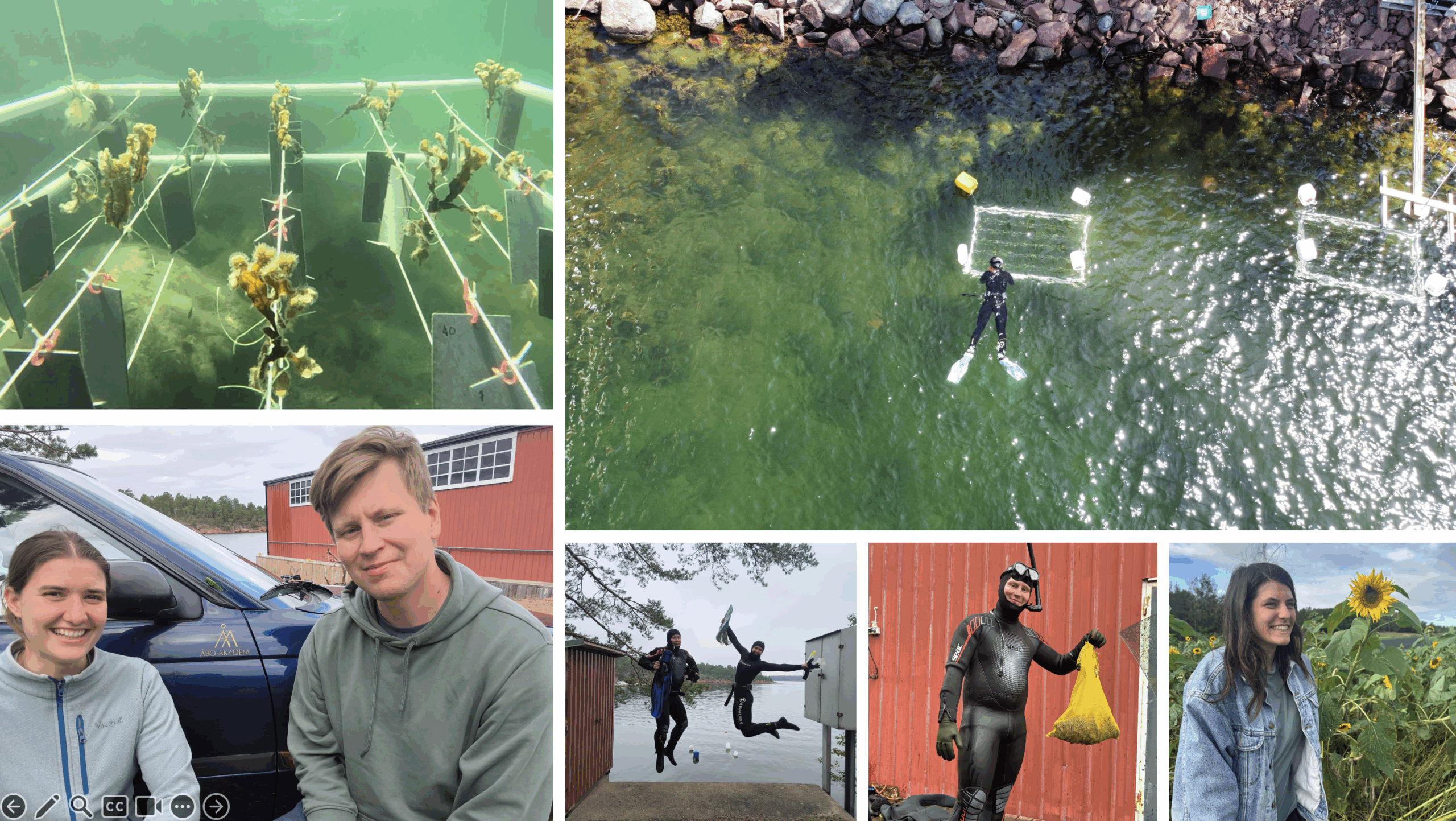
This 2025 GAME project on artificial light pollution tests its influence on marine epiphytes simultaneously and worldwide.
This year’s GAME Team are Linus Holmlund (from Åbo Akademi University, Finland)
& Pauline Wasle (from Faculdade de Ciências e Tecnologia, Portugal); later, Sarah Holldack (University of Potsdam, Germany) joined the team.
GAME 2025 at Husö Biologiska Station will Explore the Impact of Artificial Light At Night (ALAN) on Fucus vesiculosus and its interaction with its epiphytic algae: GAME 2025 will focus on the competition between epiphytes and macroalgae. If nocturnal artificial light favours epiphytes, this could lead to a shift in the competitive relationship towards a stronger growth of epiphytes, which in turn could lead to a decline in the horizontal and vertical distribution of macroalgae. By this, artificial light at night could lead to a restructuring of marine benthic habitats. The experiments will be carried out in open water, as a natural pool of spores and cells must be available for the epiphytes to colonise. Appropriate locations by the sea near the GAME partner institutes have already been identified in previous projects. At these sites, it will be possible to permanently install and operate artificial light sources (LED) and place a submersed setup to which macroalgal thalli or thallus sections can be attached.
Read more about Pauline, Linus, and Sarah here:
“Hej hej, I’m Pauline from Germany, currently doing my Master’s in Marine Biology at the University of Algarve in Portugal. During my Bachelor in Biology in Hamburg, I spent a year in Bodø, northern Norway, researching subarctic marine ecosystems, which inspired my thesis on seasonal and spatial differences in cryptofaunal communities in rhodolith beds.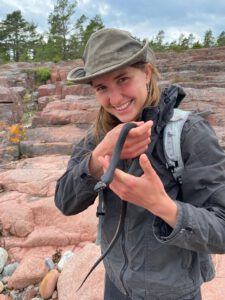
I’ve always been fascinated by ecology, and for my Master’s thesis with GAME 2025 I’m now exploring experimental ecology, where we’re looking at how artificial light at night affects epiphytes on marine macrophytes. I’m excited to research on Åland further north again, experiencing the pronounced seasonal changes and seeing how they are reflected in our experiments!”
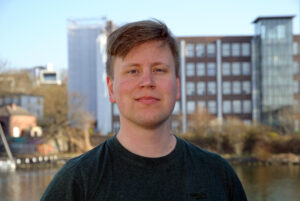
“Hi, I’m Linus Holmlund, a Master’s student in Environmental and Marine Biology at Abo Akademi University. I have a background in Electrical engineering and computer science, but moved over to Marine biology as the work is both more connected to nature and outdoors. I also enjoy how it combines “hard and soft sciences” and allows for investigations into complex emergent systems on molecular to societal scales.
 GAME felt like a unique opportunity to work within the international scientific community, make some new friends
and try my hand at experimental design in the field. It will be interesting to dive into both light pollution and epiphytic communities and see if we can find some clarity in these somewhat understudied fields.”
“I’m Sarah, and a Master’s student in Ecology, Evolution and Conservation at the University of Potsdam.