2027 – 2030 – PhD project # Emma Holmback within the doctoral programme of Biosciences, Environmental and Marine Biology at Åbo Akademi University: “Spatio-temporal changes of Baltic Sea epifaunal communities across environmental gradients”
Main supervisor; co-supervisors: Assoc. Prof. Marie C. Nordström – University of Helsinki and docent Tiina Salo – Finnish Environment Institute (Syke)
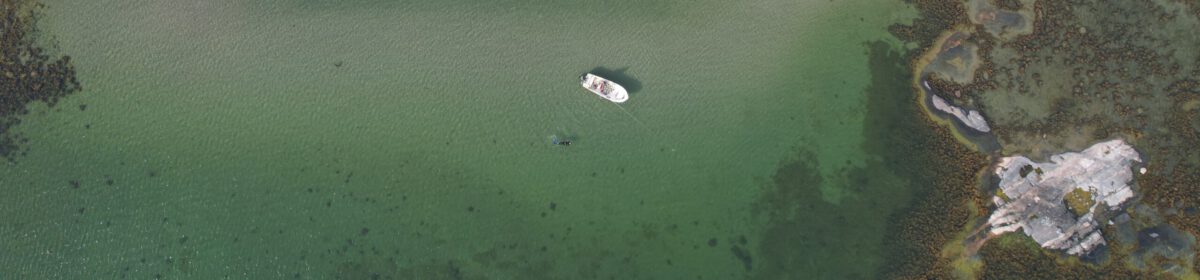
This thesis aims to assess how epifaunal biodiversity and community composition vary across spatial, temporal, and environmental gradients in Baltic Sea seagrass habitats. It investigates the relative importance of biotic interactions and abiotic drivers, including wave exposure, temperature, and water quality, in shaping macrofaunal communities. By integrating observations of present-day patterns with historical trends and experimental warming scenarios, the thesis seeks to improve understanding of how coastal ecosystems may respond to ongoing and future environmental change.
2026 – 2029 – PhD project # Lauri Kuismanen within the doctoral programme of Biosciences, Environmental and Marine Biology at Åbo Akademi University: “Drivers of underwater biodiversity patterns and targeting mitigation actions in a morphometrically complex archipelago – Integrating extensive high-resolution data”
Main supervisor; co-supervisors: Matias Scheinin – Turku University of Applied Sciences, and Louise Forsblom – Finnish Environment Institute (Syke))
The research aims to determine (1) how environmental drivers shape marine species distributions
and community composition over time, and (2) how well biodiversity is accounted for in marine
monitoring, especially in morphometrically complex systems such as the Archipelago Sea.
2025 – 2028 – PhD project # Amalia Skrifvars within the doctoral programme of Biosciences, Environmental and Marine Biology at Åbo Akademi University: “Resilience of Arctic and Subarctic Phytoplankton to Rising Sea Surface Temperature”
Main supervisor, Co-supervisor: Giannina Hattich – ÅAU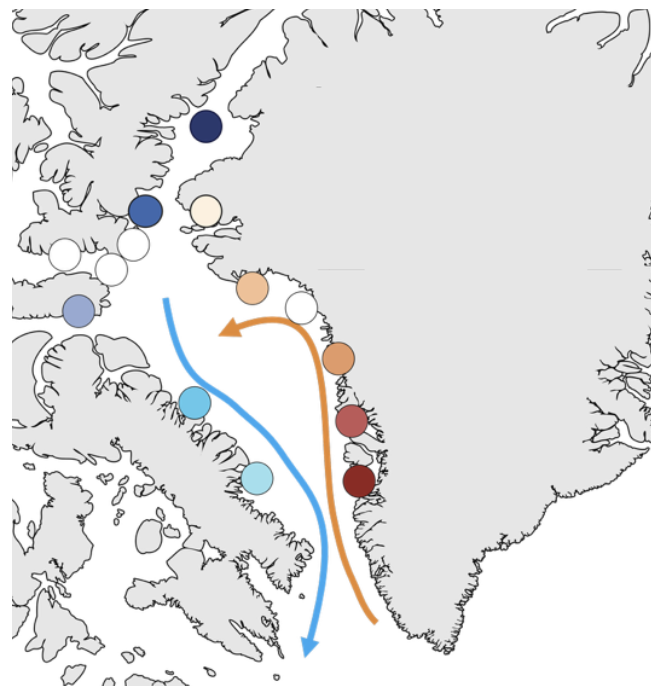
The project investigates how climate change affects phytoplankton in the Arctic. The research focuses on quantifying intraspecific diversity and species’ adaptability to warming and extreme light conditions. Through genetic analysis of Baffin Bay over time and space, population structures and distribution patterns are mapped. The aim is to investigate whether temperate genotypes can invade the Arctic and whether extreme temperature and light conditions in the Arctic affect their ability to establish. The project is expected to increase understanding of phytoplankton’s adaptability to climate change and provide important information for climate models.
2023 – 2027 – PhD project # Sarah Rühmkorff within the doctoral programme of Biosciences, Environmental and Marine Biology at Åbo Akademi University: “Resilience of Seagrass Ecosystems through Habitat Heterogeneity and Genetic Diversity”
Main supervisor and PI
Archipelagic highly dynamic environmental (temperature) gradients challenge organisms to adapt and survive, as they have to cope with rapid changes over multiple temporal scales. Importantly, it is unknown how the environmental background can shape the response of seagrass to heat stress and if seagrass living in high-variability environments (more stress), can adapt better towards heat stress than sheltered 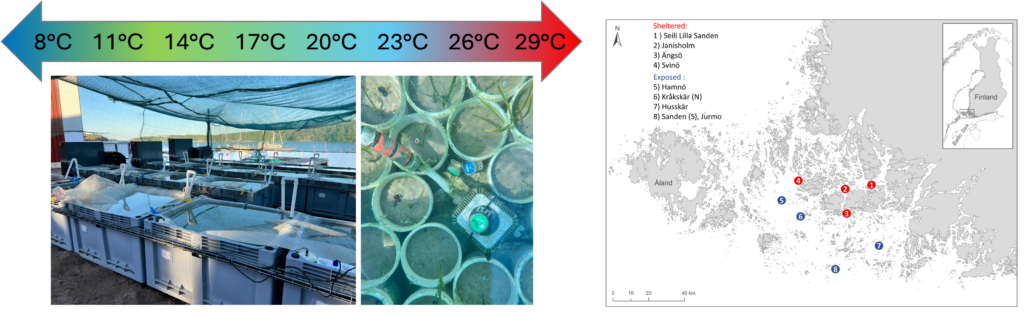 seagrass (environment more constant). The predominantly monospecific, but presumably phenotypically diverse seagrass meadows in the Archipelago Sea, therefore, provide an ideal model system to test this concept. Through the simulation of thermal gradients in mesocosm settings, this project (a) quantifies phenotypic traits of selected seagrass populations across and within seagrass clones, (b) assesses their potential for adaptation to environmental change on heat resistance, and (c) correlates population origin with heat tolerance and distinct ecological functions (e.g. nutrient uptake, sediment stabilisation).
2021 – 2026 – PhD project # Lucinda Kraufvelin within the doctoral programme of Biosciences, Environmental and Marine Biology at Åbo Akademi University: “Impacts of marine heatwaves on the functioning of temperate coastal ecosystems under the influence of non-indigenous species”
Main supervisor and PI
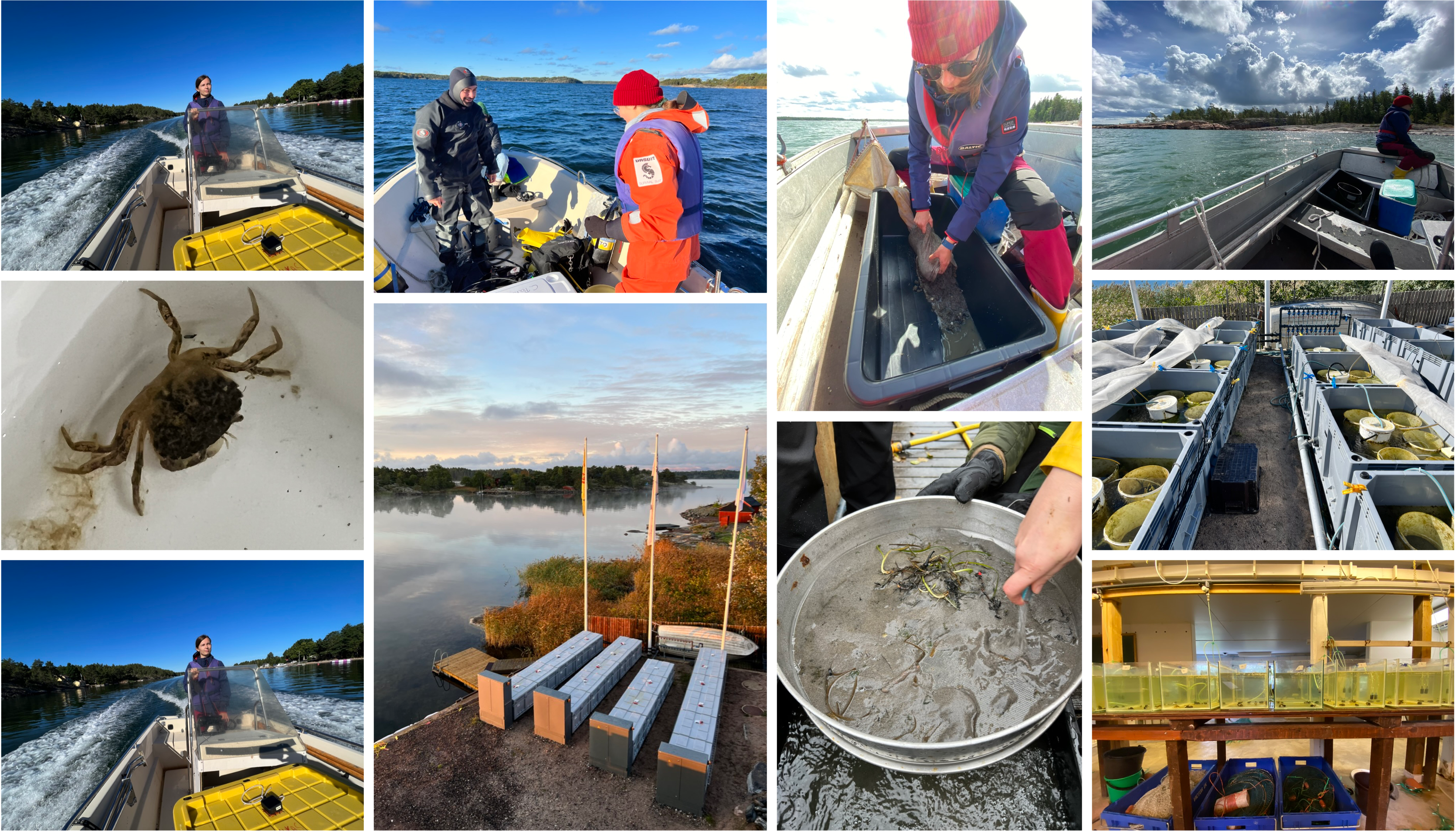
The objective of the proposed research is to (i) determine the effects of marine heatwaves on the functionality of critical temperate coastal ecosystems. Additionally, this research aims to (ii) examine the impact of marine heatwaves on selected non-indigenous species, as well as (iii) to determine whether responses of native species to marine heatwaves are affected by the presence of the chosen non-indigenous species, and (iv) to clarify if and how these responses may alter the functionality of a stressed system.
PREVIOUS (since 2019)
2019 – 2022 – PhD project # Extreme Events in the Baltic Sea – Fabian Wolf DBU Fellowship

- Photos partly by Fabian Wolf and Sarah Rühmkorff.
Main supervisor and PI
Extreme events like heatwaves and hypoxic upwelling events are projected to occur more often in the future. This project aims to understand the effect of these extreme events on typical Baltic Sea species communities. A 22-year long temperature dataset of the Kiel Fjord is used to analyze and model heatwaves and coldspells, so that the experimental treatments resemble naturally occuring extreme events.